

Analyze this page using the TAPoRware tools.
Excerpt 1: Lady Reason's Definition of Love1
Folio 36rb |
|
|
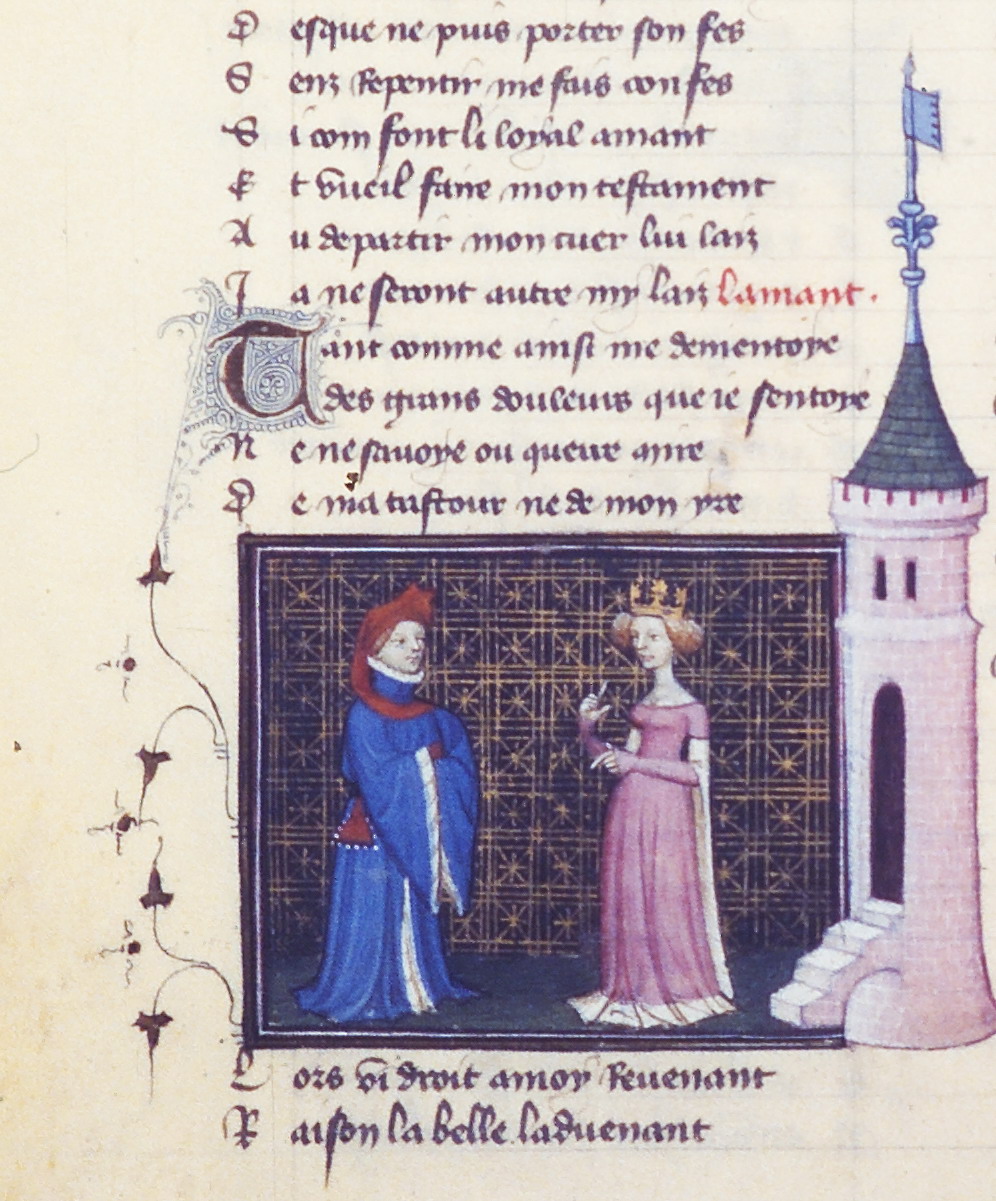
Tant com ainsinc me dementoie des grans douleurs que je sentoie
ne ne savoie ou querre mire
4 de ma tristece ne de m'ire, |
While I moaned thus about the great sorrows I was suffering, not knowing where to seek a remedy for my grief and affliction, |
 |
|
|
lors vi droit a moi revenant
Reson, la bele, l'avenant,
qui de sa tour jus descendi
8 quant mes conplaintes entendi.2 |
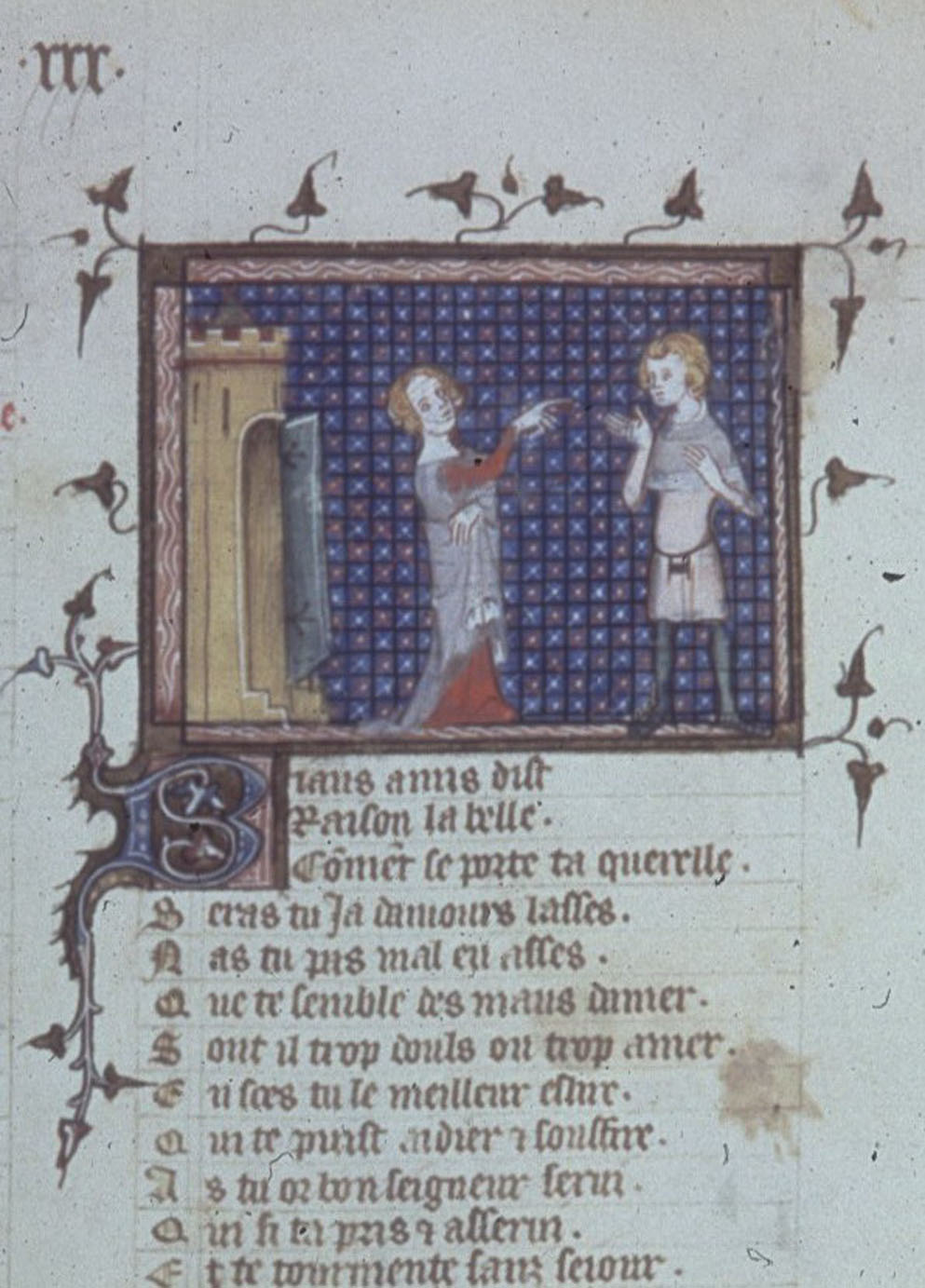
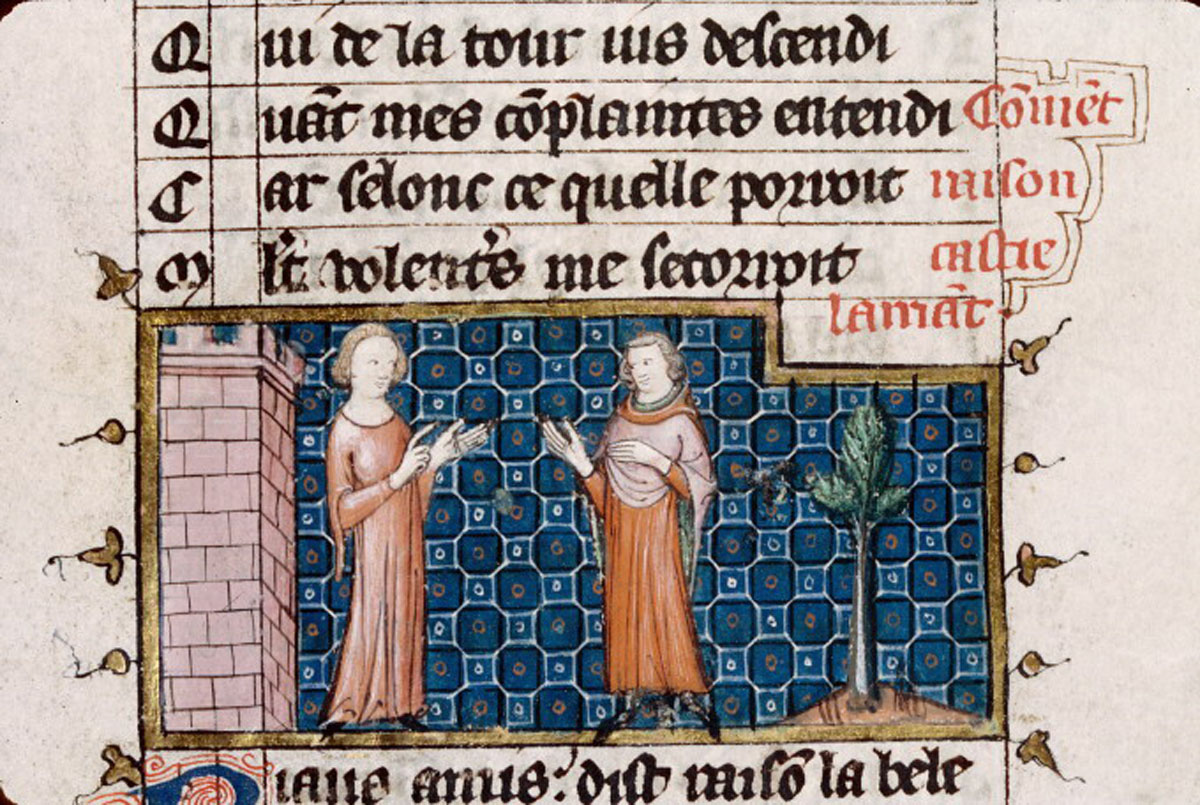
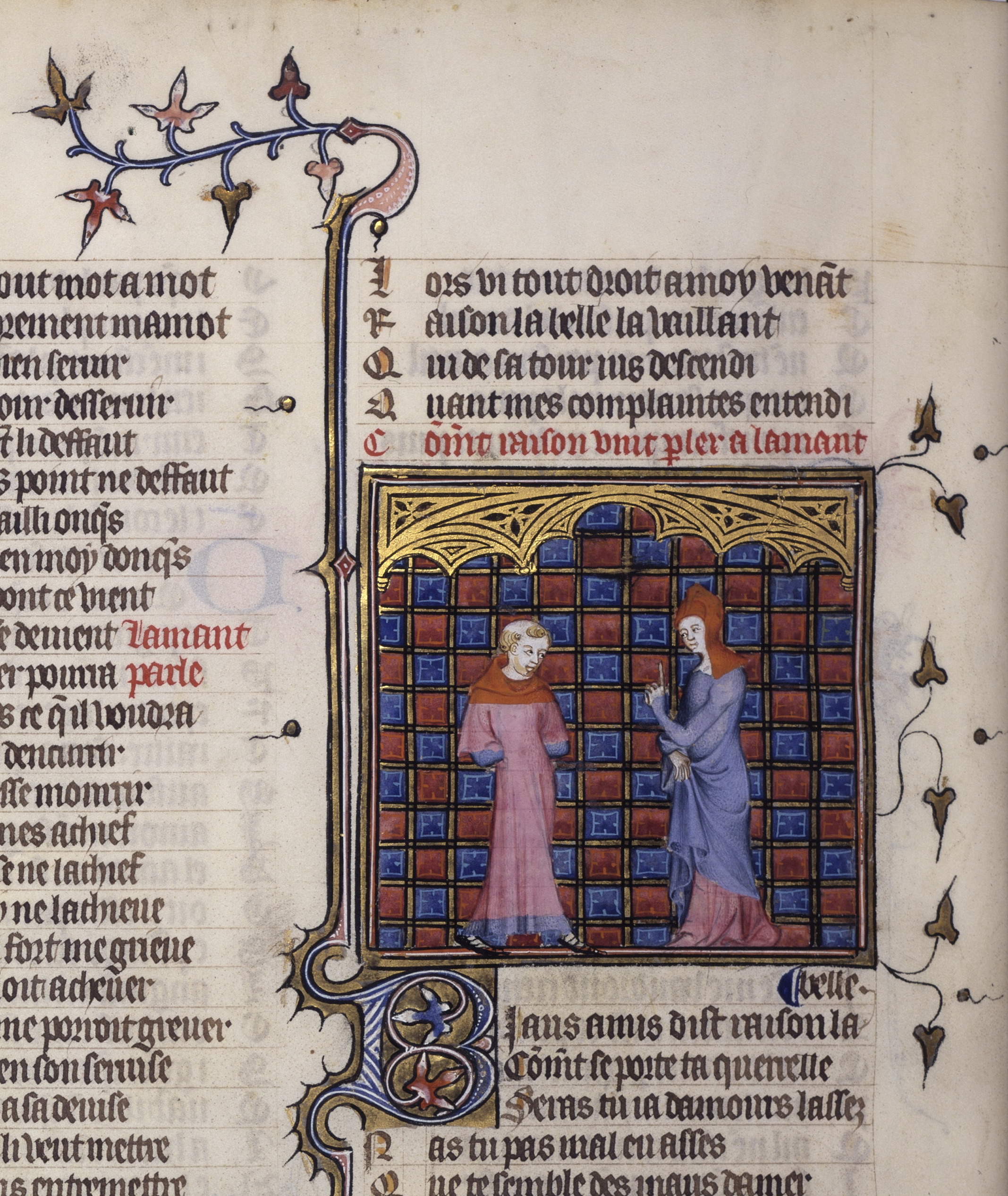
I saw fair Reason coming straight back towards me. She had descended from her tower because she heard my complaints. |

| |
|
'Beaus amis, dist Reson la bele, conment se porte la querele?
Seras tu ja d'amer lassez?
12 N'as-tu pas eü mal assez?Que te semble or des maus d'amer?
Sunt il trop douz ou trop amer?
Sez en tu le mean eslire
16 qui te puist aidier et soffire?As tu or bon seigneur servi,
qui si t'a pris et aservi
|
'My fair friend,' said Reason the fair, 'how is our discussion going? Will you be tired of loving one day? Have you not suffered enough? How do the woes of love seem to you? Are they too sweet or too bitter? Are you capable of choosing the proper mean among them, the appropriate degree which would suffice? Is he a good lord who has thus captured and subjugated you and who torments you without respite? |
Folio 36va |
|
|
et te tourmonte sanz sejour?
20 Il te meschaï bien le jorc'onques homage li feïs.
Fox fus quant a ce te meïs;
mes sanz faille tu ne savoies
24 a quel seigneur affere avoies;quar se tu bien le conneüsses,
onques ses hom esté n'eüsses;
ou, se tu l'eüsses esté,
28 ja nous servisses ·i· esté,non pas ·i· jour, non pas ·i· heure,
ainz croi que sanz point de demeure
son homage li renoiasses
32 ne ja mes par amor n'amasses.Quenois le tu point? - Oïl, dame.
- Non fez. - Si faz. - De quoi, par t'ame?
- De tant qu'il me dist : 'Tu dois estre
36 moult liez, dont tu as si bon mestreet seigneur de si haut renon.'
- Quenois le tu de plus? - Je non,
fors tant qu'il me bailla ses regles
40 et sanz foï plus tost c'uns egles,et je remés an la balance.
- Certes, c'est povre connoissance.
Mes or veill que tu les connoisses,
44 qui tant an as beü d'angoissesque touz an iés desfigurez.
Nus las, chetis, maleürez
ne peut fes enprand greigneur.
48 Bon fet connoistre son seigneur, |
The day you swore homage to him was an unlucky one for you; you were a fool to avail yourself to him. But undoubtedly you did not know what kind of a lord you were dealing with and if you had known him well, you would never have become his subject, or if you had, you would not have served him for even one summer, nor for a day, not even for an hour, but without delay, I think, you would have renounced your homage to him and would never have loved for love. Do you really know him if just a little?'
'Yes, my lady.' 'Because he said to me: you should be very joyful since you have such a good master and a lord of such great renown.' 'Do you know him any further?' 'Well, no, except that he gave me his commandments, then flew away quicker than an eagle while I remained in uncertainty.' 'There you go. This is indeed a poor acquaintance; but now I want you to learn to understand him for you have suffered so much torment that you find yourself completely defaced. No unhappy and unlucky wretch can support a greater load. It is a good thing to know one's lord; |
Folio 36vb |
|
|
et se cetui3 bien conoissoies,
legierement issir pourroies
de la prison4 ou tant anpires.
52 - Dame, voir, puis qu'il est mes sireset je ses hom liges entiers,
moult i entendist volentiers
mes queurs et plus an apreïst,
56 s'i fust qui leçon l'en preïst.- Par mon chief, je la t'en veill prendre,
puis que tes queurs i veust entendre.
Or te demonstreré sanz fable5
60 chose qui n'est pas demonstrable,6si savras tantost sanz sciance
et connoistras sanz connoisance
ce qui ne peut estre seü
64 ne demonstré ne conneü,quant a ce que ja plus en sache
nus hom qui son queur i atache
ne que ja pour ce mains d'en doille,
68 s'il n'est tex que foïr le7 voille.Lors t'avré le neu desnoé
Que touriorz trouveras noé.
Or i met bien l'entencion:
72 Voiz en ci la descripcion.Amors ce est pez haineuse, Amors c'est haine amoureuse,
C'est leautez la desleaus,
76 C'est la desleautez leaus,C'est poar toute asseüree,
C'est esperance desesperee,
|
if you knew him well, you could escape easily from the prison where you are thus wasting away day after day.'
'My lady, it is true: since he is my sire and I am wholly his liege, my heart would listen willingly and would learn more about him, if there were someone who could teach it.' 'By my head, I want to teach you, since your heart wants to apply itself. Now I shall show you without fable what is not demonstrable. You shall know straightway without knowledge and understand without understanding what can never be better known, demonstrated, or understood - at least in such a way that every man who fixes his heart on love will know more without however suffering less, unless he is the sort that may wish to flee from love. Then I will have untied the knot for you that you will always find tied. Now give me your attention; here is its description [of love]. Love is hateful peace, love is hate in love. It is disloyal loyalty, it is loyal disloyalty; it is fear that is completely confident, it is hope in despair. |
Folio 37 ra |
|
|
C'est reson toute forsenable
80 C'est forcenerie resnableC'est douz perilz a soi noier
Grief fes legiers a paumoier
C'est Caribdis la perilleuse
84 Desagraable et gracieuse,C'est langueur toute santeïve,
C'est santé toute maladive,
C'est fain saoule en habondance,
88 C'est conoiteuse souffisanceC'est la soif qui touriorz est ivre,
Ivrece qui de soif8 s'enivre,
C'est faus deliz, c'est tristeur liee,
92 C'est leece la corrouciee;Douz mal, douceur malicieuse,
Douce saveur mal savoreuse,
Entechiez de pardon pechiez
96 De pechiez pardon enthechiez;C'est peine qui trop est joieuse,
C'est felonie la piteuse,
C'est li geus qui n'est point9 estables,
100 Estaz trop fers et trop muablesForce enferme, enfermeté fors,
Qui tout esmeut par ses efors,
C'est fol sans, c'est sage folie,
104 Prosperité triste et jolie,C'est ris plains de pleurs et de lermes,
Repos travaillanz en touz termes
Ce est enfers li doucereus
108 C'est paradis li doulereus, |
It is reason completely mad, it is reasonable madness; it is sweet danger of drowning, chagrin easily handled. It is treacherous Charybdis, repellent but lovely. It is healthy languor, it is very sick health; it is hunger drunk with abundance, it is satisfaction always covetous. It is thirst always drunk, drunkenness intoxicated by thirst. It is false delight, it is joyous sadness.
It is enraged happiness. Sweet pain, malicious sweetness, ill-smelling sweet perfume. [Love] is a sin tarnished by pardon; pardon tarnished by sin. It is suffering which is too joyous, it is a piteous cruelty. It is a pleasantry which is not secure, a state too powerful and too fickle. It is an infirm force, a strong infirmity that moves all by its efforts. It is foolish reason, it is wise folly; sad and appealing prosperity. It is laughter filled with tears and weeping; rest which constantly labours. It is sweet hell, it is painful paradise, |
Folio 37rb |
|
|
C'est chartre qui prisons souglage,10
Printens plein de froit ivernage,
C'est taigne qui riens ne refuse,
112 Les pourpres et les buriaus use,Car ausic bien sont amoretes
Souz buriaus comme souz brunetes,
Car nus n'est de si haut lignage
116 Ne nul n'en11 treuve l'en si sageNe de force tant esprouvé
Ne si hardi n'a l'en trouvé
Ne qui tant ait d’autres bontez
120 Qui par amors ne soit doutez.Touz li mondes va cele voie:
C'est li dex qui touz les desvoie,
124 Que genius escommenie,Pour ce qu'il font tort a nature.
Ne pour ce, se ie n'ai dels cure,14
Ne veill ie pas que les genz aiment
128 De cele amor dom il se claimentEn la fin, las, chetif, dolant,
Tant les vet amors affolant.15
Mes se tu vieuz bien eschever
132 Qu'amors ne te puissent16 grever,Et vieuz garir de ceste rage,17
Ne puez beevre si bon bevrage18
Comme penser de lui fouir:
136 Tu n'en puez autrement ioir.Se tu le fuiz, il te suivra,
Se tu t'en fuiz, il s'en fuira.19
|
it is the prison which solaces captivity; spring full of cold winter. It is the moth that refuses nothing and consumes purple robes as well as homespun, for lovers are as good beneath coarse as beneath fine clothing. For no one can be
found, however high his lineage or however wise, of such proved strength, bravery, or other good qualities, who may not be subjugated
by Love. The whole world travels that road: it is the God [of Love] who deters them all from their road. It is only those of evil life whom Genius excommunicates because they commit wrongs against Nature. Since I have nothing to do with them, I do not wish people to love with that love by which at the end they proclaim themselves unhappy, sorrowful and suffering because that is how much Love afflicts them. But if indeed you wish to overcome this in order for Love to be unable to harm you, and to be cured of that rage, there is no better drink than the thought of fleeing from him. You can not be happy in any other way. If you follow him, he will follow you; if you flee, he will flee.
|
Folio 37va |
|
|
Quant i'oi bien reson antendue 140 Qui pour naiant s'est debatue:Dame, fis je, de ce ne me vant,
Je n'en20 sai pas plus que devant,
A ce que m'en puisse retraire.
144 En ma leçon a tant contraire,Que ie n’en puis neant aprendre.21
Si la sai ie bien par queur rendre,
C'onc mes queurs riens ne22 oblia
148 Donc23 entendre qanqu'il i a,Pour lire en tout communement,
Ne mes a moi tant seulement.
Mes puis qu'amor m'avez descrite
152 Et tant loee et tant despite,Prier vous veill dou defenir
Si qu'il m’en puist mieuz24 sovenir,
Quar ne l'oi defenir onques.
156 Raison'Volantiers, or i'entent donques.
|
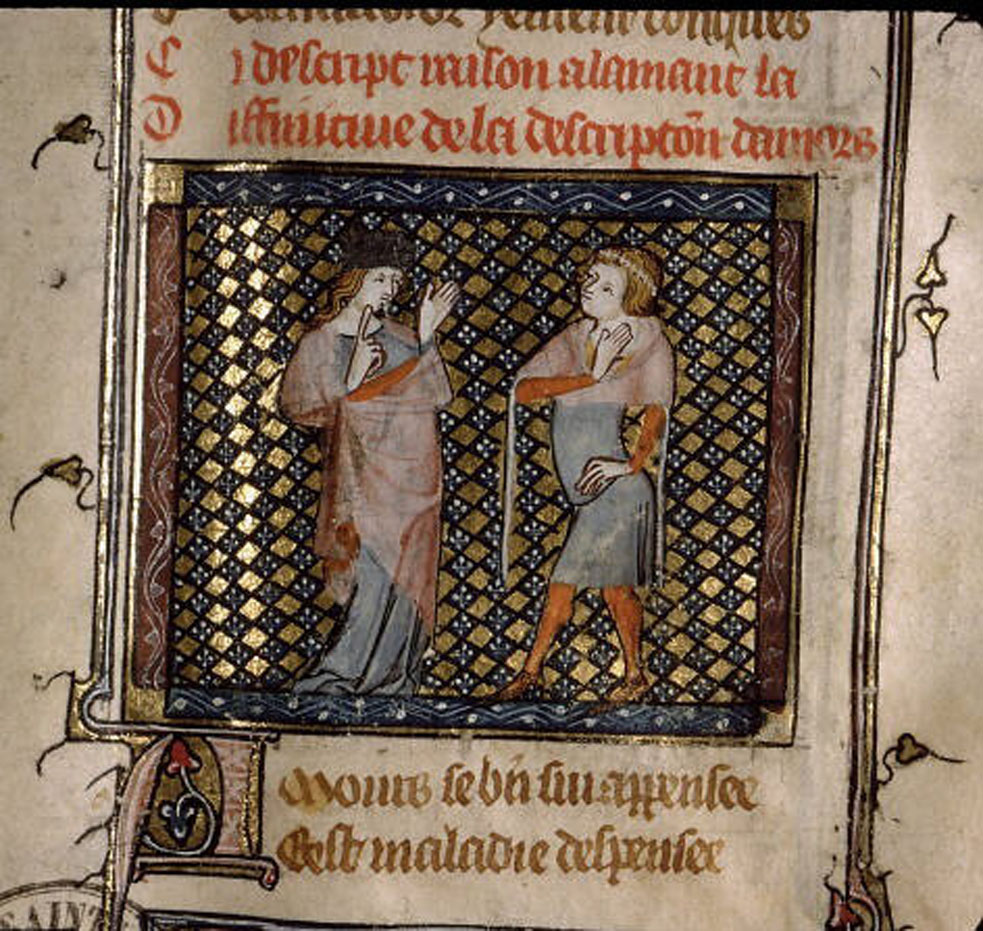
When I listened carefully to Reason, who argued in vain, I replied: “Lady, I flatter myself that I know no more about this than before: of how I can extricate myself from love. In my lesson, there are so many contraries that I can learn nothing from it. If I know to repeat it well by heart, for my heart never forgot it, and I understand all there is, I can read it publicly, yet to me alone it means nothing. But since you have described love to me, and have praised and blamed it so much, I beg you to define it in such a way that I may better remember it, for I have never heard it defined.' |
|
|
|
Amours, se bien sui apensee, C'est maladie de pensee
160 Antre ·ij· persones annexe,Franches entr'els, de divers sexe,
Venanz a genz par ardeur nee
De vision desordenee,
|
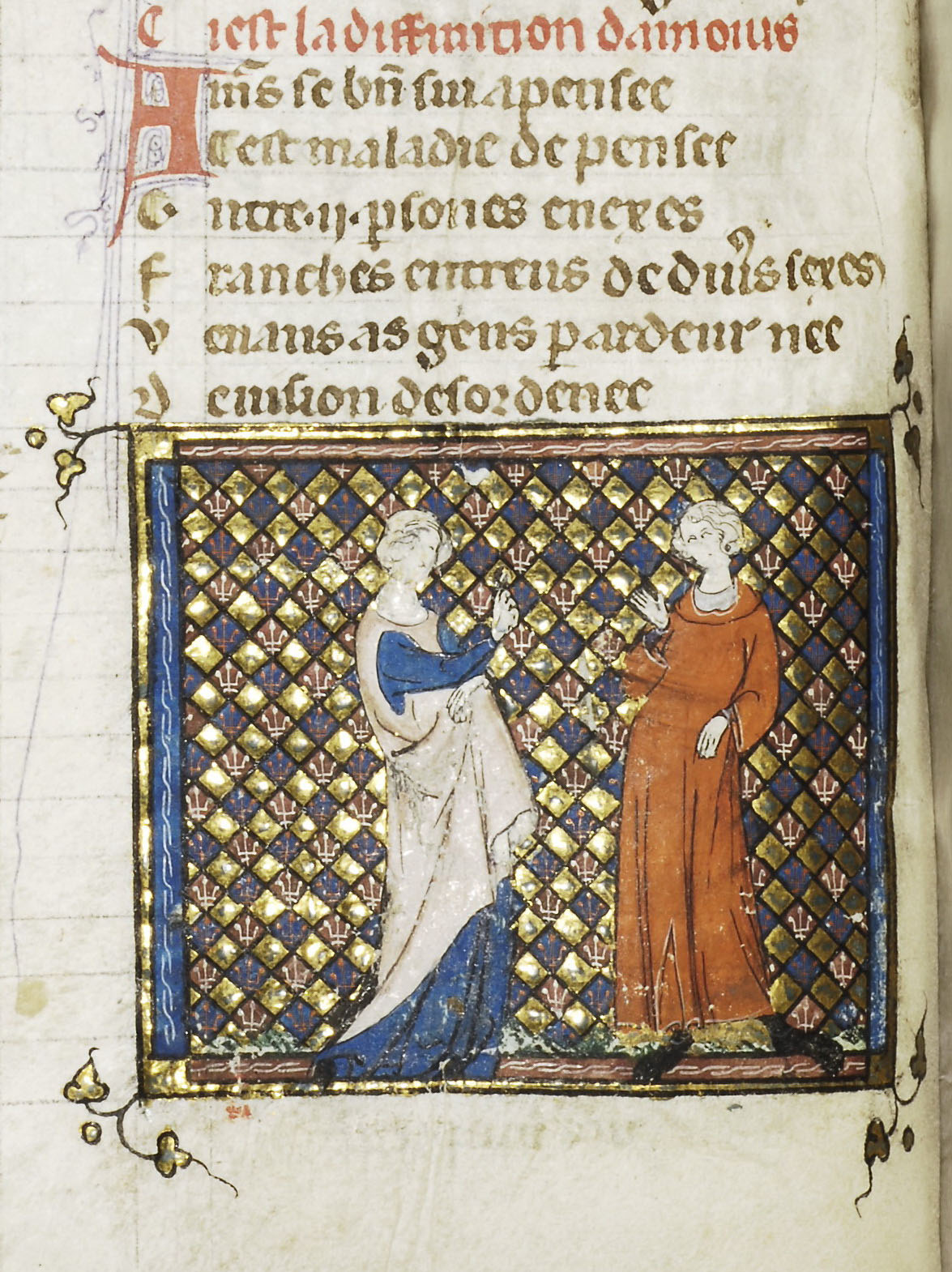
Love, if I think correctly, is a sickness of thought that takes place between two persons who are close to and open with each other and of different sex. It arises in people from burning desire, born of disorderly glances, |
|
|
|
164 Pour acoler et pour besier,Pour els charnelment aesier.
Amant autre chose n'entant,
Ainz s'art et se delite en tant;
168 De fruit avoir ne fet il force, |
to embrace and kiss each other and to have the solace of one another's body. A lover so burns and is so enraptured that he thinks of nothing else; he takes no account of bearing fruit, but strives only for delight.
|
Folio 37vb |
|
|
S'il25 sunt aucun de tel maniere
Que ceste amour n'ont mie chiere,
Toutevois fins amanz se faignent,
172 Mes par amors amer ne daignentEt se gabent ainsinc des dames
Et leur prometent cors et ames,
Et jurent menconges et fables
176 A cels qui trouvent26 decevables,Tan qu’il ont leur delit eü.
Mes cil sont le mains deceü
Car adés vient il mieuz, beau mestre
180 Decevoir, que deceüz estre;Meesmemant en ceste guerre,
Quant le maien ni27 sevent querre.
|
There are those of a certain kind who do not hold this love dear, yet who always pretend to be courtly lovers. However, they do not deign to love for love and thus deceive ladies by promising them their hearts and souls and by swearing lies and fables to those whom they find gullible, until they have taken their pleasure with them. But such people are less deceived than the others; for it is always better, good master, to deceive than to be deceived, particularly in this war, when one never knows how to find the right medium.
|
Notes
1This passage corresponds to lines 4218 to 4398 in Armand Strubel's edition and to Vol. I, lines 4191 to 4372 in Félix Lecoy's edition.
2The following two lines are missing: 'Car selonc ce qu’el porroit/Moult volentiers me secorroit'.
3tu
4chartre
5faille
6devinaille
7s'en
8Yvrece qui touz jours enyvre
9pas
10Chartre qui prisonniers solage
11Ne nus ne
12Se
13de male voie
14Et pour ce, se je n'ai d’aus cure
15Tant vait lor amours affolant
16puisse
17de cel malage
18meilleur bevrage
19Se tu le fuiz, il te fuira
20ne
21Que je n'en sai nul mot entendre
22n'en
23Voire
24'mieuz' is missing.
25Si
26u'il tiennent
27ne